

 City and travel
Where to stay for Fira Barcelona: Gran Via or Montjuïc?
Planning a trade fair trip to Barcelona? Fira Gran Via and Montjuïc are different venues. Compare their locations, nearby hotel areas, airport connections and practical booking criteria before choosing accommodation.
Booking accommodation for a trade fair in Barcelona seems straightforward. Search for “hotel near Fira Barcelona”, select a rating and a price, and you are done. Yet that search can lead to the wrong side of the city. Fira de Barcelona operates more than one venue. The event you intend to attend might be at Gran Via or at Montjuïc, and the best base for one is not necessarily convenient for the other.
Gran Via, at Avinguda Joan Carles I, 64, is in L’Hospitalet de Llobregat, a municipality adjoining Barcelona. Montjuïc, at Avinguda Reina Maria Cristina, s/n, is in Barcelona itself, next to Plaça d’Espanya. Their principal stations, street approaches and surrounding neighbourhoods differ. Both are connected to the public transport network, but that is not the same as being within an easy walk of the same hotel.
This is not a list of supposedly “best” hotels. It is a practical way for visitors and exhibitors to decide where to look for accommodation, based on the exact event entrance, the workday schedule and the journeys they will repeat. Begin with the exhibition address; consider rooms and prices only after that.

1. Two Fira Barcelona sites, two different hotel searches
Fira de Barcelona’s official venue list includes Gran Via, Montjuïc and the separate CCIB convention centre. This guide compares Gran Via and Montjuïc only. If your registration email names CCIB, do not follow directions meant for either of the other venues. Its address is different.
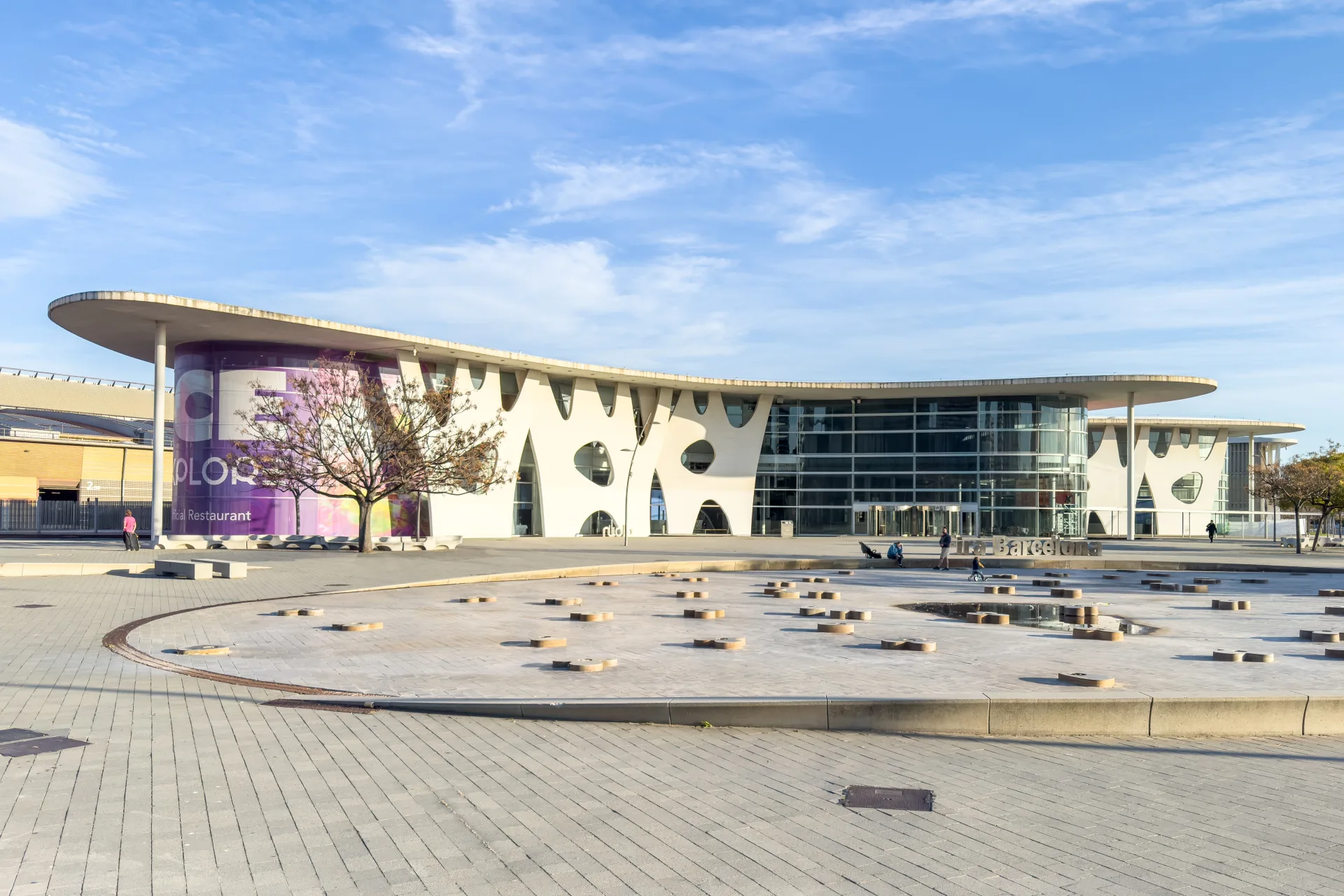
Gran Via is a large, contemporary exhibition complex used for major international trade events. It is officially located in L’Hospitalet de Llobregat. A hotel listing may still describe itself as being in “Barcelona”; that wording does not establish the distance from your specific hall. Staying in the adjoining municipality is entirely reasonable if the actual journey is convenient.
Montjuïc occupies a more central historic site near Plaça d’Espanya and the approach to Montjuïc hill. The area offers another kind of base: an urban transport interchange, established neighbourhood streets and straightforward connections towards Barcelona-Sants railway station. It may fit an itinerary that combines a trade fair with meetings elsewhere in town.
Practical reference | Gran Via | Montjuïc |
|---|---|---|
Official address | Av. Joan Carles I, 64, 08908 L’Hospitalet de Llobregat | Av. Reina Maria Cristina, s/n, 08004 Barcelona |
Key stations | Fira, Europa/Fira; Foc for some approaches | Espanya |
Rail connections | L9 Sud, FGC at Europa/Fira, L10 Sud at Foc | L1, L3 and FGC at Espanya |
Hotel decision | Your hall entrance and the walking route to it | Easy access to Espanya and the event entrance |
Neither location is the “better” exhibition centre in general. Your event chooses the venue. Booking beside Montjuïc because it sounds more central makes little sense when every morning starts at Gran Via.
2. Confirm the entrance before looking at hotels
Open the organiser’s own page for your specific event. Find the venue name, the hall or pavilion and the visitor entrance. Save the current access map. Some invitations merely say “Fira Barcelona”; if yours does, ask the event team for the exact address instead of relying on whichever location appears first in a map search.
A fairground is more than a point on a map. It can have different entrances for visitors and exhibitors, service roads, temporary flow controls and registration areas. A hotel directly opposite a perimeter fence is not necessarily opposite a public door. That difference matters when you have an early meeting or carry samples.
If you are exhibiting, identify the access instructions for setup, credentials and deliveries as well as the normal public entrance. If you are attending only as a visitor, check which gate accepts your ticket category. A busy day can include parallel events with different entrances even at the same complex.
Only then compare accommodation. Drop your map pin near the actual entrance you will use, not the centre of the venue parcel. Calculate a route for the morning arrival and another for the evening return. A stated distance of “600 metres from Fira” is not sufficient evidence that either journey is short or step-free.
3. Staying near Gran Via: Plaça d’Europa and L’Hospitalet
If several full exhibition days take place at Gran Via, start by reviewing accommodation around Plaça d’Europa and the business district of Granvia L’Hospitalet. Some properties may offer a practical walking approach to the complex, potentially saving daily commuting time. The obvious caution is that walking convenience varies by side of the venue, entrance and street layout.
The Europa/Fira area is particularly useful to understand because the station is served by L9 Sud and FGC services. FGC links Europa/Fira with Espanya, creating an option for evening meetings closer to central Barcelona and for transfers towards Montjuïc. Still check the distance from the station exit to the hotel and from your arrival station to the selected hall.
Fira station on L9 Sud is another important reference for Gran Via. It is on the metro line from Barcelona airport, which simplifies travel from T1 or T2 to the exhibition district. But being near a station in a hotel description is not proof of comfortable access with luggage. View the actual pedestrian route and check whether the relevant access points are available on your event date.
A different option is to stay around Plaça d’Espanya and use FGC to reach Europa/Fira. This can suit a visitor spending part of the day at the fair and the rest in business meetings or restaurants within the city. It means a regular commute rather than a short stroll. Decide whether that trade-off fits your itinerary before paying.
An airport-area hotel is not automatically optimal for Gran Via merely because the metro has a direct route from the terminals. Airport hotels can be far from the relevant metro entrance and require shuttle transfers. Such a location might be sensible for a late arrival or early flight, but it can be a poor base for several consecutive exhibition days.

4. Staying near Montjuïc: Espanya, Hostafrancs and Sants
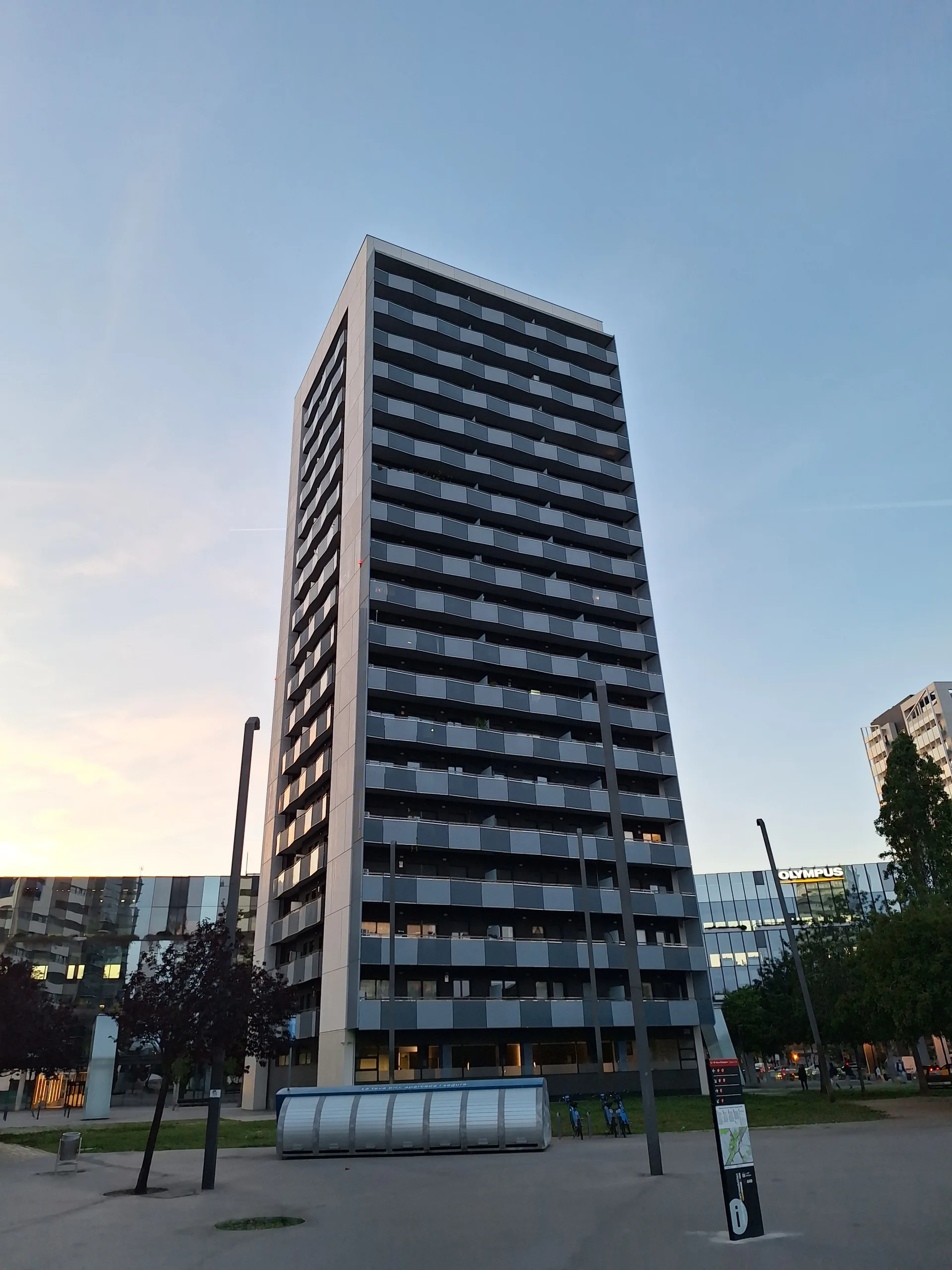
For an event at Montjuïc, Plaça d’Espanya is the first place to look on a map. The fairground’s official address is on Avinguda Reina Maria Cristina, and Espanya is the main rail and metro reference. If your priority is to return to the hotel on foot, inspect the surrounding streets and the actual entrance approach rather than relying on the radius shown in a hotel-search filter.
Hostafrancs and the neighbouring streets near Espanya offer another practical search area. Metro lines L1 and L3 are relevant to the venue, and the district may suit visitors who want a straightforward return after long days on the show floor. Evaluate the real room conditions, street noise, stairs and reception hours as carefully as you evaluate transport.
Sants deserves attention if you arrive by train, plan onward rail travel or have meetings across Barcelona. Barcelona-Sants station connects with the metro, and Fira’s official Montjuïc directions identify L3 to Espanya. They also give an approximately 15-minute walk along Carrer de Tarragona from the station to the fairground in suitable circumstances. That is guidance for the station-to-venue approach, not a guarantee from every hotel advertised as being in Sants.
Poble-sec can also be considered if you want a local urban neighbourhood and are comfortable with a short journey or walk towards Espanya. The exact street matters: the wider district is not uniformly close to the exhibition entrance. Also distinguish the Montjuïc fairground from Montjuïc hill; they are not interchangeable destinations in a navigation app.
An appealing location for sightseeing is a bonus, not a reason to ignore a difficult morning journey. A trade fair itinerary is tiring enough without adding unnecessary transit or uphill approaches at both ends of the day.

5. When you need both Gran Via and Montjuïc
Some business trips include an exhibition at Gran Via, a conference at Montjuïc and evening meetings elsewhere in Barcelona. In that case, a hotel beside the busiest pavilion may or may not be the most useful base.
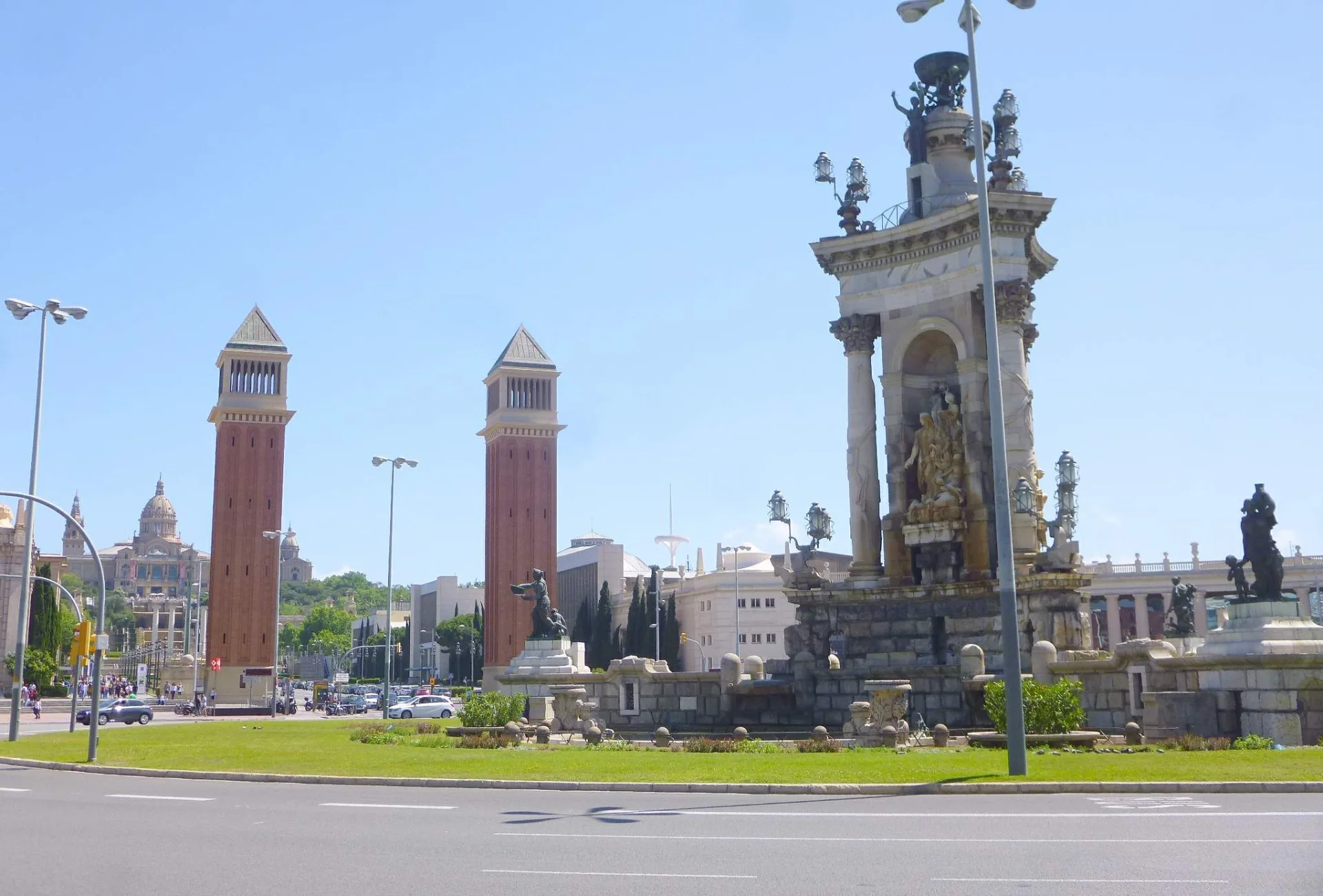
Espanya is worth comparing first. Montjuïc is nearby, while FGC services from Espanya reach Europa/Fira, giving access to the Gran Via district. A railway connection does not erase the last walk to your actual hall entrance, so include it in your calculation.
Sants is relevant when rail travel is central to the trip. It provides useful city connections and an approach to Montjuïc via Espanya. For Gran Via you need to plan a different journey; do not assume that being at a major transport hub means every exhibition hall is nearby.
Apply a simple weighting rule. If you are working full days at Gran Via for three days and attending one evening function at Montjuïc, prioritise the three repeated journeys. If the programme is mostly at Montjuïc, the reverse is reasonable. The right compromise minimises the total burden of travel, rather than aiming for an imaginary halfway point between two venue labels.
6. From Barcelona–El Prat Airport to the right area
Barcelona–El Prat Airport has T1 and T2 passenger terminals. L9 Sud connects both terminal metro stations to the network and passes through Fira and Europa/Fira. That makes Gran Via relatively simple to reach by metro from the airport: no change of metro line is needed to reach the exhibition district. But your door-to-door time includes getting off the plane, immigration where applicable, baggage, moving to the metro, and the final walk with luggage. It cannot be reduced to the published train running time.
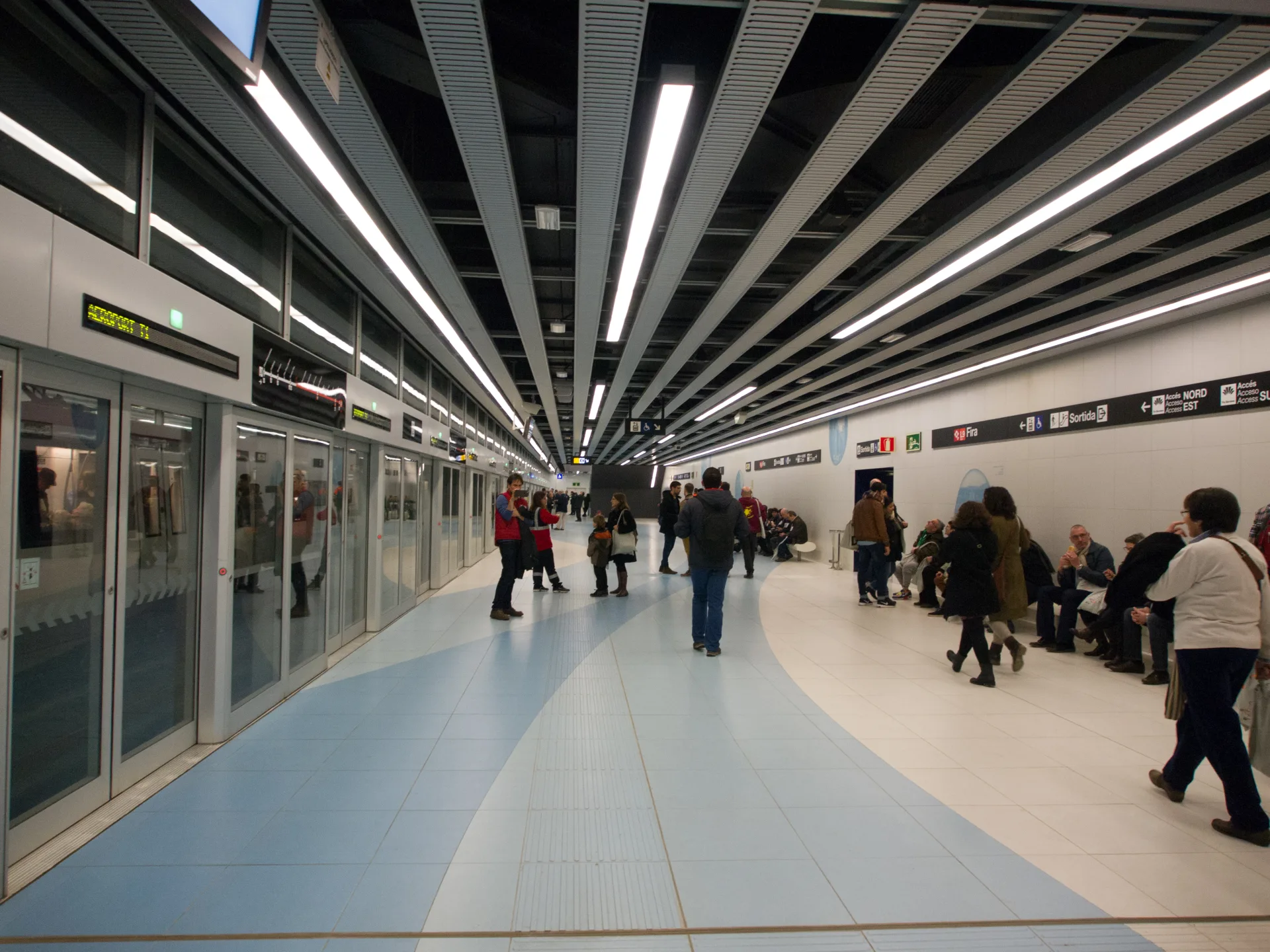

For Montjuïc, Fira’s official directions suggest L9 Sud to Torrassa, then L1 to Espanya. Other options include Aerobús towards the Plaça d’Espanya area, certain city buses and a train connection via Barcelona-Sants for suitable arrival routes. What is most convenient depends on your terminal, hotel address, baggage and travel time. A bus without a metro interchange may be preferable for some passengers; a rail route may be more predictable when roads are busy.
Airport metro ticket warning: ordinary single tickets and T-casual are not valid for entering or leaving the Aeroport T1 and Aeroport T2 metro stations on L9 Sud. Buy a ticket or use a pass valid for the airport stations, such as the Airport Ticket or an eligible travel pass. This restriction does not mean T-casual is invalid for the whole L9 Sud line. The operator TMB publishes the current rules and tariffs; check them before you travel.
Your return flight may require another solution. A public transport route that is perfectly comfortable with a small bag after arrival may be less practical with equipment before an early flight. Check the departing terminal and allow time for airport procedures rather than scheduling your departure from the exhibition too tightly.
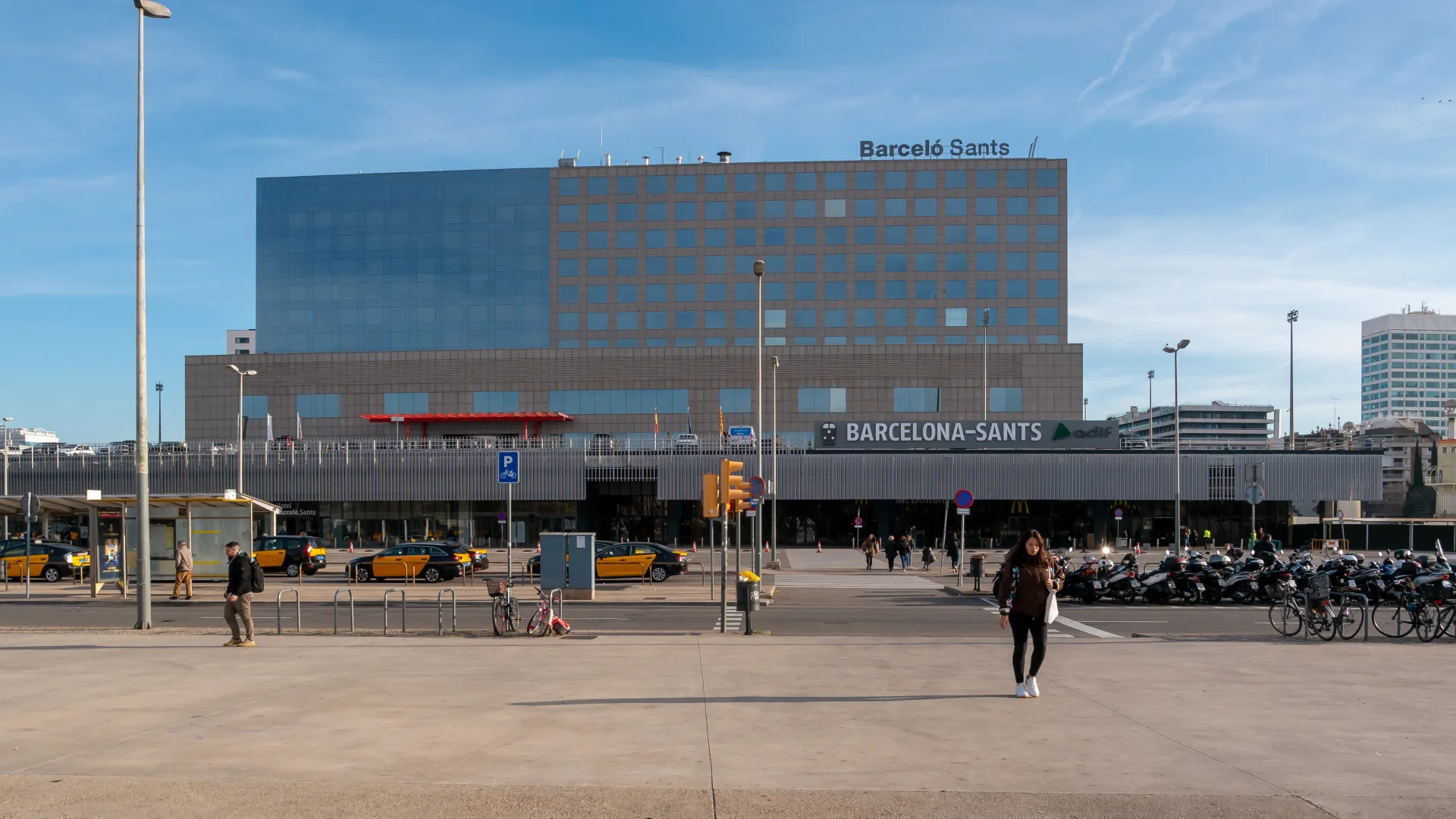
7. Arriving by rail at Barcelona-Sants
Barcelona-Sants is a major rail interchange. For visitors attending Montjuïc, metro L3 to Espanya is a straightforward official option. The organiser also lists walking along Carrer de Tarragona as a possibility, with an approximate station-to-venue indication. Use that as context, not a fixed promise for a walk with heavy luggage or in uncomfortable weather.
For Gran Via, Fira states that Barcelona-Sants is approximately 4 km from the fairground. It is therefore misleading to treat a hotel at the railway station as if it were on the doorstep of Gran Via. Plan a suitable transit or vehicle route rather than assuming a short walk.
Choosing a Sants hotel is sensible if train services and city meetings feature prominently in your schedule. It is less compelling if your only goal is to reach Gran Via for five early starts and you have an equally suitable option with a genuinely easier connection to the venue.

8. Compare hotels by real journeys, not straight-line distances
Imagine two hypothetical hotel listings. One advertises “900 metres from the fair” but is nearest a closed perimeter or the wrong approach. Another is a couple of transport stops away with a simple, accessible route to the actual entrance. The first property is closer as the crow flies; the second may be more convenient in practice. This is an illustration of how to evaluate listings, not a statement about specific hotels.
Check eight things before deciding:
Verified address: the location on the hotel’s own website matches the booking platform.
Journey to your entrance: not merely the centre of the fairground.
Morning connection: interchanges, walking, stairs and any potential queues.
Evening return: whether the same route remains practical when events finish.
Full booking cost: included charges, local taxes, deposit and cancellation terms.
Work facilities: reliable internet, a place to work and reasonable call conditions.
Arrival and departure arrangements: reception hours and luggage storage.
Other journeys: airport, station and business meetings beyond the exhibition.
The phrase “near Fira Barcelona” needs a second look. Some listings refer to Montjuïc, others to Gran Via. A search label is not a substitute for the site address and venue entrance.
Do not rely on a generic “best hotels” ranking without inspecting dates, prices, location and selection criteria. Accommodation availability and conditions change significantly around large events. This guide intentionally makes no live-price, room-availability or personal-stay claims.
9. Venue-side hotel or city hotel: which works better?
A hotel near Gran Via often makes more sense for exhibitors with early setup, full days at the stand, equipment or repeated journeys. Saving even a modest amount of travel effort twice a day may make the work schedule easier over several days.
Staying near Espanya is a clear option when Montjuïc hosts the event, particularly if you want straightforward access to the city after it closes. The decision should still account for your chosen entrance, evening transport and the actual street where the room is located.
Staying deeper in central Barcelona may be reasonable if the fair occupies only part of the trip. Dinner meetings, client visits and some time to explore the city may outweigh a short transfer to the venue. Just be realistic: your exhibition journey then becomes an everyday commute.
Staying in Sants can work particularly well for a multi-city visit or repeated rail journeys. Its value lies in the combined itinerary. There is no universally best neighbourhood independent of the timing and geography of your meetings.
10. Three typical trips, three different choices
Case A: Four full working days at Gran Via
An exhibitor needs to arrive early and may carry materials. Start with Plaça d’Europa, Europa/Fira and hotel entrances on a verified route to the correct fairground gate. Check whether late return is comfortable, whether reception is staffed when you arrive and whether the room can handle some paperwork. Access to the historic centre is secondary.
Case B: A one-day visit to Montjuïc by train
If you arrive at Barcelona-Sants and leave later the same day, review Sants and Espanya before making a wider search. Avoid unnecessary journeys with bags. You may not need overnight accommodation at all, but you will need a safe and legitimate plan for storing luggage if the exhibition does not permit it.
Case C: Two Gran Via days plus meetings across the city
Write down the real hours of the programme. Are the client meetings late? Will you return to the room between appointments? Is the fair an early start? Compare Plaça d’Europa with Espanya and other areas that offer a clear transit route. City-based accommodation may win if most activity is outside the venue; Gran Via proximity may win if the fair dictates the schedule.
These examples illustrate the decision process. They are not endorsements of any named property or guarantees of a particular journey time.
11. Before paying for a non-refundable room
Compare your check-in and checkout dates with the actual exhibition programme. Landing on the opening morning can leave too little time for registration and the first meeting. Checking out before the final planned appointment may create a luggage problem. An additional night at the right point in the itinerary can sometimes help more than a more expensive room elsewhere.
Read exactly what the rate includes: breakfast, local taxes, mandatory fees, cancellation deadlines, late arrival, deposit and whether a proper business invoice can be issued. Confirm who provides the invoice if the booking goes through an intermediary. A price displayed “per night” may differ from the total you will actually pay.
For a team, consider whether colleagues can reach the same entrance at the same time, not just whether their hotels are described as being “near Fira”. If you bring samples or materials, ask about storage and reception arrangements rather than assuming you may leave everything in the room at any hour.
Consult Fira’s current venue pages and the TMB airport metro guide. Even the organiser’s general map must be supplemented with the instructions for your particular event.
12. Plan the return journey, not just the morning arrival
Visitors usually calculate how to reach the venue but leave the journey home to chance. A busy exhibition can end with crowded exits, a meeting that runs late or changed dinner plans. An easy, direct return to the hotel is worth more on those evenings than a complicated transfer that looks manageable on paper.
If you have a flight after the exhibition, the time the halls close is not the time you leave for the airport. You still need to reach the correct gate, exit the complex, find transport, reach the correct terminal and complete airline and airport formalities. “A few metro stops from the airport” is not a complete flight plan.
Check operating hours for late returns, an alternative if your first route is disrupted and the accessibility of the entire journey if required. A metro station close to the fairground does not by itself guarantee a step-free route from the platform to your specific hotel or exhibition entrance.
13. The five-step hotel decision
Before opening a booking platform, follow this sequence:
Confirm whether the event is at Gran Via, Montjuïc or another venue.
Save the specific hall and entry gate from the event organiser.
Begin your search around Plaça d’Europa / Europa-Fira for Gran Via, or Espanya / Sants for Montjuïc, adjusting for other commitments.
Calculate both morning and evening door-to-door routes, including the last walk.
Only then compare total price, cancellation conditions, workspace and hotel services.
The most useful rule is simple: “near Fira Barcelona” does not necessarily mean near your fair. A good hotel choice removes friction from a business trip and leaves more time and energy for the people you came to meet.
Official sources
Keep reading
Getting to Messe Düsseldorf: airport, city centre and exhibition entrances
A practical guide to reaching Messe Düsseldorf from Düsseldorf Airport (DUS), the central station and the city centre. Understand the new U80/U81 links, choose the right entrance and plan a productive exhibition day.

Madrid Airport to IFEMA MADRID: how to reach the right entrance
A practical route from Madrid-Barajas Airport to IFEMA MADRID: Metro Line 8, T1–T3 and T4 arrivals, airport ticket rules and the right exhibition gate.
Where to stay for a Shanghai trade show: choose the venue first
SNIEC, NECC and SWEECC are not in the same part of Shanghai. Compare the right hotel areas, metro stations and venue entrances before booking for your trade show.